
10 квітня 2026 р.
Service-based businesses increasingly rely on CRM and scheduling platforms to manage bookings, client communication, and daily operations. Two solutions that often appear in this space are DIKIDI and Planch.
Both platforms are designed to help businesses organize appointments, manage clients, and automate workflows. However, they differ significantly in their approach, target industries, and overall user experience.
In this comparison, we’ll look at how these systems work, which types of businesses they serve best, and when a modern alternative like Planch might be the better option.
DIKIDI is an international online booking platform designed primarily for service businesses that rely on appointments, such as salons, freelancers, and wellness providers. The platform allows businesses to manage schedules, maintain a client database, and enable online booking through websites, social networks, or the DIKIDI marketplace.
Many professionals use DIKIDI because it offers a free entry plan and quick setup, making it accessible for small studios and independent specialists.
Typical industries using DIKIDI include:
beauty salons
barbershops
nail studios
fitness trainers
wellness services
private specialists and freelancers
The platform focuses heavily on appointment scheduling and marketplace visibility, helping service providers attract and manage customers.
Planch is a modern CRM and appointment management platform designed specifically for service businesses that want more control over their operations.
Instead of focusing only on booking, Planch combines:
CRM functionality
workflow automation
appointment scheduling
client communication
analytics and reporting
This approach allows businesses not only to manage bookings but also to understand customer behavior, retention, and operational performance.
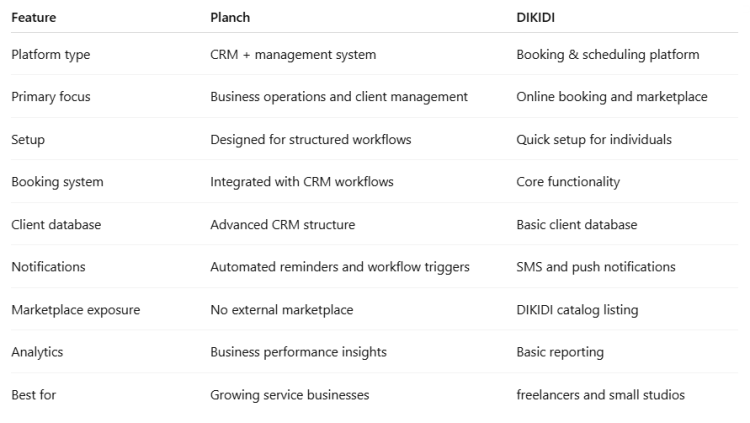
DIKIDI is known for its quick onboarding process. Businesses can create an account, add services, and start accepting bookings within minutes. This simplicity makes it attractive for freelancers and small studios that need a fast solution.
Planch, on the other hand, is designed as a more structured CRM platform. While setup may involve configuring workflows, services, and staff roles, the result is a system that supports long-term business growth.
In practice:
DIKIDI works well for solo specialists or very small teams
Planch is better suited for studios and service companies planning to scale
Both platforms provide appointment scheduling.
DIKIDI focuses heavily on booking accessibility. Customers can book through:
the DIKIDI mobile app
a booking widget on websites
social media links
the DIKIDI marketplace catalog
This makes it easy for businesses to attract new clients through the platform’s ecosystem.
Planch offers booking features as well but integrates them more deeply into CRM workflows. Booking is not only about scheduling appointments but also about managing:
client history
service preferences
communication
operational insights
For businesses focused on client retention rather than marketplace exposure, this structure can be advantageous.
One of the biggest differences between the platforms is how they treat client data.
DIKIDI includes a client database that stores visit history, contact information, and appointment statistics.
However, its primary goal is still scheduling.
Planch positions CRM at the center of the system. This means businesses can track:
client preferences
visit patterns
revenue trends
repeat bookings
This allows service businesses to better understand their customers and improve long-term relationships.
Automation is another area where the platforms differ.
DIKIDI offers automation features such as:
appointment reminders
automated notifications
booking confirmations
These tools are useful for preventing missed appointments.
Planch expands automation beyond scheduling. Businesses can automate:
reminders and notifications
internal workflows
service bundles and memberships
client communication sequences
This allows companies to reduce administrative work and improve operational efficiency.
DIKIDI provides basic reporting tools that help businesses track sales, visits, and customer activity.
These reports are helpful for understanding daily operations.
Planch focuses more on business analytics and performance insights. Companies can monitor:
service performance
staff productivity
booking trends
customer retention
For businesses that rely on data-driven decisions, these insights can play a major role in improving profitability.
Both systems aim to improve the customer experience.
DIKIDI enables clients to easily find service providers, book appointments, and receive reminders through notifications or messages.
Planch focuses more on the long-term relationship between the business and its clients. Instead of acting as a marketplace, the platform allows companies to maintain direct control over customer communication and brand experience.
DIKIDI is often a good choice for:
freelancers
independent beauty specialists
small studios with minimal administrative needs
businesses that want visibility in booking marketplaces
Its quick setup and free plan make it an accessible entry-level option.
Planch may be a better fit for businesses that:
want a structured CRM system
need advanced automation
manage multiple employees or locations
rely on customer data and analytics
want to build long-term client relationships
In these cases, a full CRM approach provides more flexibility than a simple scheduling platform.
Both DIKIDI and Planch aim to simplify the management of service-based businesses.
DIKIDI is a strong solution for professionals who need a fast and accessible appointment booking system.
Planch takes a broader approach, combining scheduling with CRM, automation, and operational insights designed to support growing service businesses.
For companies that want to move beyond simple booking tools and build a more scalable management system, Planch can serve as a modern and powerful alternative.
22 березня 2026 р.
Спробуйте наші послуги без зобов’язань. Підвищте ефективність вашого бізнесу, покращте взаємодію з клієнтами та спростіть усі процеси. Почніть працювати з нами і відчуйте всі переваги вже зараз!